
Ingenuity at work beneath the wastewater surface
“Sometimes, I’m like ‘Ah darn, it’s a long weekend!’”
Imagine loving your job SO much that you dread an extra day off. That is Lee Allen’s reality.
“On Sunday nights, I’m always looking forward to being at work tomorrow. I’m stoked to get here and do what I do.”
Lee is Senior System Integrator at the Lethbridge Wastewater Treatment Plant (WWTP). And what he ‘does’ is quite remarkable. His latest project tackles a previously unseen safety issue.
For years, WWTP staff knew hydrogen sulfide was a problem. The poisonous, flammable and corrosive gas was eating away at parts of the plant. They could see the damage in the open areas. But a mystery lay in the long, dark, maze-like channels that carry wastewater underground. The channels are sealed to protect workers from dangerous gas levels, and pausing treatment operations to inspect them isn’t an option.
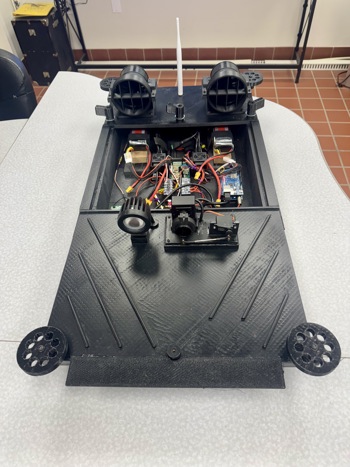 An airboat drone for concrete channels inspections at the wastewater treatment plant.
“There was no good way to peek inside,” says Lee. “It’s a small, enclosed concrete channel with no inspection ports and you can’t put a person down there.”
Initial ideas included floating a GoPro camera on a piece of Styrofoam or an inner tube. But battling an upstream current and maneuvering around bends made that a non-starter. The solution needed to float, turn sharply and survive tight, cramped spaces.
“Last September (WWTP Maintenance Lead) Sean Young came into my office and said, ‘I have the best project for you: a drone boat!”
That’s all Lee needed to hear. The next three months involved 3D printing, wiring, assembling, coding and a whole lot of testing... all while performing his regular daily duties! The end result: an airboat-style drone powered by dual jet drives and remotely controlled with an Xbox 360 controller. The entire process is captured on this YouTube video.
It’s a project born from Lee’s early love of tinkering.
“My dad was a heavy-duty mechanic, always welding something in his backyard garage,” recalls Lee. “I grew up using his tools, taking things apart and putting them back together. I got hooked on remote control (RC) projects early and built my first airboat at 12 or 13. It didn’t look great and it barely worked, but I learned a lot. Since then, I’ve built more RC machines than I can count.”
Aside from Lee’s engineering, maybe the most impressive part of his latest drone is its meager price tag. Similar commercial models can cost upwards of tens of thousands of dollars. Lee’s homebuilt model cost less than $1,000.
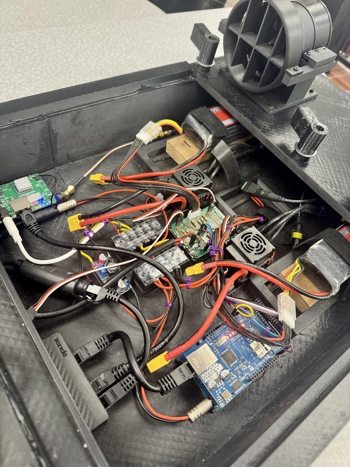 The inner workings of the airboat drone.
“Having access to the on-site 3D printer is huge,” says Lee. “You still need some technical knowledge to work with the tools, but you don’t have to be a lifelong expert in each field. It’s more like Lego, where you can glue inexpensive, pre-made modules together rather than building circuits from scratch.”
Before sending it underground, Lee and the team tested the drone on a local storm pond. Once it proved it could skim, pivot and stay upright, they opened the sealed channel at the plant - carefully.
Alberta’s dangerous exposure limit for hydrogen sulfide is 10 parts per million (ppm), and the sealed channel showed readings around 35 ppm. Because that air stays fully contained underground, it isn’t a safety concern. When the team sent the drone through, they watched it skim along the surface and were relieved to see the walls were in better shape than expected.
The drone also uncovered something else: a thick buildup of grease and organic matter clinging to the channel floor and walls. It wasn’t catastrophic, but it would need flushing. Without the drone, no one would have known. And without support from his higher-ups, Lee couldn’t have created the drone.
“I’ve been so fortunate because the three plant managers I’ve worked under have been super supportive and stood behind my ideas,” he says.
That includes current WWTP Manager Adam Campbell.
“This project is beneficial on so many levels,” says Adam. “It tackles a real issue, it’s very cost-efficient and it creates a high level of team engagement. It’s great to watch Lee combine his personal interests and wide-ranging skillset at work every day.”
Lee emphasizes none of his drone projects are about replacing human jobs. They improve processes and safety.
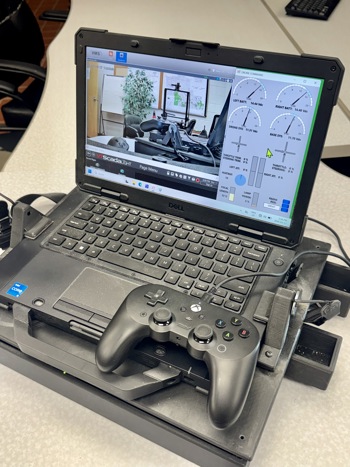 The control centre for the airboat drone.
“Our systems take on the dirty, dangerous, boring work humans shouldn’t have to do, like inspecting toxic channels. I believe robots should make human work safer, more fun and more meaningful.”
For Lee, the drone wasn’t just a clever fix. It was another chance to turn childhood tinkering into real-world problem solving. He’s already building his next tool to tackle sludge removal in the wastewater lagoons. And once again, he’s showing that innovation thrives in the hands of someone who simply can’t wait for Monday morning!
Contact Us
City Hall
910 4 Avenue South
Lethbridge, AB T1J 0P6
Phone: 311
or 403-320-3111 (if outside of Lethbridge)