Environment Week 2026

The City of Lethbridge is encouraging residents to connect with, care for and celebrate our beautiful local environment during Environment Week! 

Environment Week is a nationwide event observed annually during the first week of June. It aims to help Canadians celebrate the environment and take action to protect it.

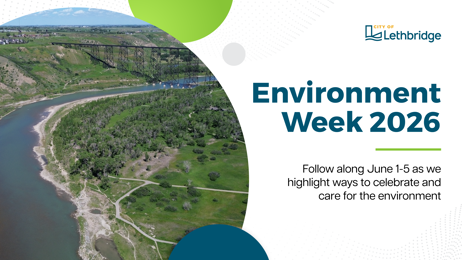
This year, from June 1-5, we are recognizing this special week through a daily series of stories to help inspire environmental stewardship within our community and provide tips to help reduce textile waste, water usage, home energy consumption and more. 

We are proud to partner with local organizations to support and promote environmental programming. For year-round events and a full list of Environment Week activities in Lethbridge, be sure to check out Environment Lethbridge and GreenYQL

Follow along at lethbridge.ca/environmentweek, and tune in next week when we kick off Environment Week with Motion Monday! 

Welcome to Environment Week! This week kickstarts our engines and revs up with Motion Monday... or does it?

Vehicle emissions are a part of urban life, but they have a big impact on our environment. In Lethbridge, traditional and fuel-powered vehicles are estimated to create nearly 332,000 tonnes of greenhouse gas (GHG) emissions each year. To put that into perspective, it’s the same amount one person would generate if they drove their car around the world – 33,000 times! Talk about a road trip!

Luckily, there are steps we can take to reduce GHGs where possible.

Public transit

Public transit is a great option for individuals and families looking to cut down on emissions and fuel costs. It’s accessible, cost-effective and linked to all sides of our city. If you’ve never been a passenger, Lethbridge Transit has educational resources available online, including 360° VR tours of:

For new, casual and everyday riders, be sure to download the MyRide app to plan your next trip.

Lethbridge Transit’s Youth Summer Pass also goes on sale today. It offers youth (ages six to 17) two months of summer fare for the price of one. Passes are valid from July 1 to August 31, 2026. Pick yours up today at City Hall or the Park ‘n’ Ride Transit Terminal.

Paved and unpaved pathways

If riding the bus isn’t your cup of tea, consider biking, scootering or walking shorter distances when driving might not be necessary. Lethbridge has an extensive paved pathway network which makes it easy to get around and stay connected.

And, for recreation, our trail network is just as vast! (Just remember to please keep e-dirt bikes off streets and out of the river valley.)


Our Environment Week thread continues with Textile Tuesday! 

Familiarize yourself with fast fashion and the impact it has on our waste infrastructure. Fast fashion refers to overproduced, low-quality trends that are sold at low prices. It’s aimed at quickly cycling clothes in and out of the market rather than durability and sustainability. 

Based on unpublished waste audit results from 2019 and 2020, the City of Lethbridge noted approximately 1,000 tonnes of textiles are trashed by households in Lethbridge each year. That’s enough cheap t-shirts to fill more than 100 dump trucks. 

We all have that one cozy sweater (you know, the one full of holes with a mysterious stain), that has more than likely passed its prime. You might be thinking it’s time to throw it out, but before you do that, consider: 

  • Patching it or making small repairs 
  • Repurpose it by cutting it into rags or using it for a craft 

Not a seamster or seamstress? Environment Lethbridge is hosting a Repair Café on Sunday, June 7, at the Lethbridge Public Library Main Branch. Attendees can bring in not only textiles, but also other broken items that may just require a bit of help from a pro. Sign up for the Repair Café and review what specialties will be available on-site. This is a great chance to give new life to landfill-bound items! 

For textiles and items too far gone, the Waste Wizard can help you find the appropriate method of disposal. If you're looking to acquire new threads instead of getting rid of some, consider thrifting. (Who knows, you might find some sweet wizard robes...)

Environment Week blossoms with Water Wednesday!

Spring is a magical season. The days are longer, the sun gets warmer and the entire city starts to turn a lush shade of green. 

Home gardens and lawns also begin to come back to life. Some plants and grasses need constant attention, which can take lots of time, money and – above all – water. However, there is a water-friendly alternative: xeriscaping! 

Xeriscaping (not zeroscaping), involves conscious vegetation choices and meaningful planning to reduce the amount of water needed to maintain an outdoor area. 

Mulch, a fundamental piece of xeriscaping, provides a moist layer that can sit above topsoil, insulating the ground below from drying solar radiation. Mulch holds in water and creates a cooler environment for your plants to thrive. Similarly, a well-maintained mulch layer can stifle weed growth – bonus! Our new social media series, Water Wise with Walter, explores water and water conservation in Lethbridge. 

Being in the middle of Lethbridge’s rainy season, it’s the perfect time to make use of our Environmental Incentive Program. The program runs until December 31 or until funding runs out. Each household can get up to two rebates for low-flow toilets and two for rain barrels. For both items, the rebate covers 50 per cent of the cost, up to $100 each.  

If you’re feeling lucky, we’re also giving away a rain barrel! Find us at the LSCO LiveWell Showcase, June 4-5, to enter the draw. 

For other information and more tools on planning and implementing other parts of xeriscaping, check out Environment Lethbridge’s Living Cities, where their Waterwise 101 series dives deeper into what your yard can do for you. To learn more about water conservation, check out our Water Wednesday series. 

Environment Week heats up with Thermal Thursday!

Although necessary for daily life, the consumption of electricity, natural gas, fuel and water can negatively impact our environment and climate. Electricity generation and water treatment often rely on burning fossil fuels, which contributes to greenhouse gases trapping heat in the atmosphere.  

Checking your home’s energy efficiency is a great way to reduce your footprint. Stop by the Lethbridge Public Library and borrow a home energy audit kit from their Library of Things! (Our Waste Wizard loves being a power saver, too.) 

The kit includes: 

  • A watt meter 
  • A thermal camera 
  • An LED lightbulb 
  • A freezer/refrigerator thermometer 
  • A radon gas detector 

Climate risks in Lethbridge include extreme heat, drought and grassfires. 

Heat warnings are issued in southern Alberta when two or more consecutive days of daytime maximum temperatures are expected to reach 32 degrees Celsius or warmer, and nighttime minimum temperatures are expected to remain at 16 degrees Celsius or warmer.   

Drought is something we deal with often in southern Alberta. The increasing occurrence or intensity of drought periods results in lower crop yields, increased stress on livestock, and higher costs and demand for limited water.  

For more information about preparing for extreme heat or drought, visit lethbridge.ca/extremeweather

Friday, June 5 - Urban Forest Friday

Environment Week branches out with Urban Forest Friday!

Our river valley is home to three very important cottonwood tree species:

  • Plains Cottonwood
  • Narrowleaf Cottonwood
  • Balsam Poplar

But what makes them so special? All three species coexist and hybridize throughout the river valley, in a unique mix that occurs nowhere else on Earth! This makes our cottonwood species extremely rare and highly specialized to thrive in our conditions.

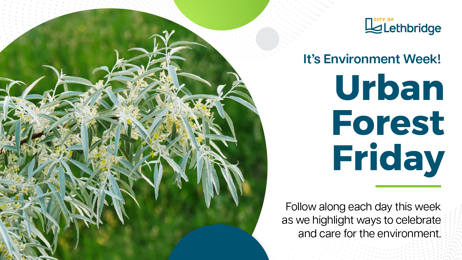
However, there’s one tree species that makes it hard for our Cottonwoods to live and grow: Russian Olives.

Russian Olives are extremely common in Lethbridge, often beloved by residents for their silvery-green foliage and their sweet summery fragrance. While these are nostalgic and enjoyable traits, they are an invasive species because they are not native to Alberta and outcompete Cottonwoods and other native species for resources within the river valley.

They grow in tight clusters with long, sharp thorns that make it difficult for wildlife and humans to travel through the forest. They shade out plants below, depriving them of energy to grow. They change the chemistry of the soil they grow in, making it hard for young Cottonwoods to establish at all.

Other well-known invasive species in Lethbridge include Spotted Knapweed, Diffuse Knapweed, Common Tansy and Canada Thistle.

Looking to get involved and help protect our parks and river valley? You can:

  • Learn about our river valley and how to identify Russian Olives by visiting lethbridge.ca/rivervalley.
  • Join the Helen Schuler Nature Centre’s Invasive Weed Pull program.
  • Join our Adopt-A-Park program, which gives you the opportunity to care for a green space in our community, including organizing trash pickups and beautification projects. (There’s one today at 5 p.m. in Tartan Park!).
  • Come to Nature Play Fest on June 13, from 12 – 4 p.m. at Henderson Lake Park. Nature Play Fest is a free event that gives children and families a chance to try new outdoor activities, including nature-inspired crafts and outdoor recreation experiences.

On that note, our Environment Week series comes to a close. Thank you for joining us in celebrating our natural surroundings and learning how small changes can make a big difference. Whether it was reducing waste, rethinking fast fashion, conserving water or exploring the great outdoors, we hope you feel inspired to keep the momentum going year-round.

And don’t forget! If you have any household hazardous waste or old electronics to dispose of, bring them to our Beyond-the-Bin Recycling Roundup tomorrow, June 6, at the northwest parking lot of Park Place Mall, from 8 a.m. to 4 p.m.